

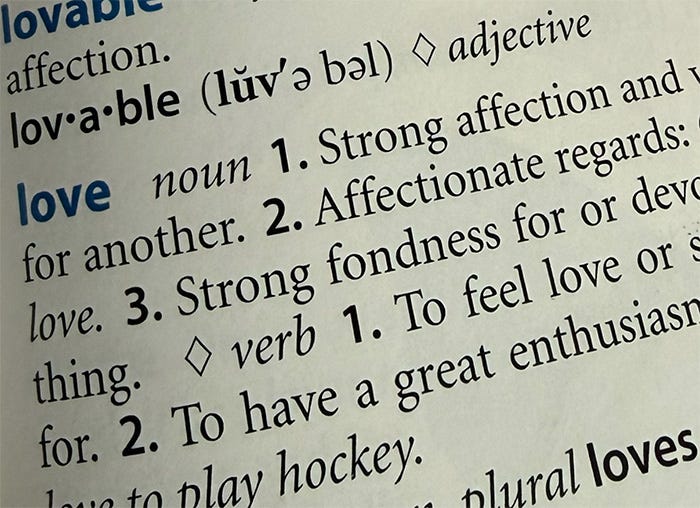
The best definition of love I have heard so far comes from one of those audios my husband tells me not to listen to while I’m driving. (Speed limits can get fuzzy when an idea stirs my interest.)
In his Erotic and The Holy series author Marc Gafni defines love this way:
Love is the consistent commitment to the growth of the other, expressed through spontaneous acts of giving.
Obsessed as I am with birth metaphors, this is my translation:
To love you, I must adore the person you are today—and be a midwife to the person you long to be born into tomorrow.
As I see it, the toughest course in the “Learning What Love Is” curriculum is not learning to love others—but learning to love ourselves.

If we were to follow the guidance of those two definitions, loving ourselves would mean recognizing when we are spontaneously giving to ourselves, and when we are just as spontaneously or habitually taking away.
Loving ourselves would mean adoring the person we are today, while remaining willing to midwife the person we yearn to be.
Loving ourselves would mean being consistently committed to our own becoming—and expressing that commitment through genuine, thoughtful acts of care.
It would also mean allowing ourselves to feel everything: the injuries, the disappointments, the real and perceived betrayals. All of it would keep clarifying what it is we hunger for.
The more difficult parts of our lives would then become the seedlings of the next Self. A time of gestation.
Anyone who has given birth—or lived through a deep inner transformation—knows that when we’re in the middle of contractions, the pain can blur our vision.
Which is why we’re not meant to labor alone. We need a hand to squeeze, steady breath beside us. And when the moment comes, someone to say —
Push!

If we choose the love-learning road—the only road worth taking—we need trustworthy helpers. Collaborators. In all my years, I have yet to meet someone who found their way on this path without companions.
Reaching out for help—to friends, teachers—and if you’re lucky, even family members—is one of the bravest acts I know. But if you don’t risk it, you’ll never know who you can—or cannot—count on.
Despite the many examples to the contrary in our hurting human family, I’m not ready to give up on the idea that it is the longing to love that unites us. No matter how distorted that longing may appears against the daily deluge of cruelty and disconnection—the wish to connect with each other lives in all of us.
And if we’re willing to keep learning—and re-learning—the art of loving ourselves, then following the the command to “love our neighbors as ourselves,” begins to make a lot more sense.
Your turn, friends:
What feels easy for you on the love-learning road?
What feels harder?
Where are you right now in the curriculum?
The core of my being has always believed in the power of connection, in 'relationality' as the essence of why we are here and how we can survive any heartache. Feeling beaten over and over and yet still finding a way to call out from the bottom of the well. It didn't feel easy, but it felt necessary. Connection to another felt like the compass back to myself. This long journey to motherhood, crushing as it has been at times, has challenged me to value myself, my gifts, my resilience, my voice and my needs in ways I never thought possible. It's awkward and messy, but I can hear a deafening roar inside now. I know I'm in that roar and I know I matter. Learning to translate the power of that roar into a language that resonates both internally and externally feels like the most sacred of tasks right now. I am deeply grateful for your stewardship in this process xx
I often put the two at odds - either accepting myself or moving towards growth. Helpful to think that these actually work together. And a beautiful concept of love, to love someone towards growth!